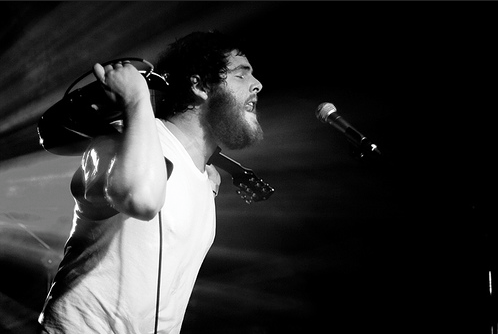
When I saw this in SugarHouse, I immediately whipped out my phone and emailed Hilary over at Team Poetry. I had read her essay on slam poetry, which had aroused my interest in the genre.
Such promise! Such excitement!
She told me to go as her proxy, and I would not fail her. After a weekend trip up to Bear Lake and Logan, I told my boyfriend to come check it out with me.
No poetry was slammed that night.
No one showed up. If you're interested in checking the slam scene out, there's more info on what was supposed to happen over on this Westminster College culture site.
Disappointing, but I probably would never have made the effort without Hilary's project to pique my interest. Additionally, their fresh-squeezed watermelon juice is excellent.
It has been debated which poetry sub-genre Robert Frost
identifies with.The Oxford English
Dictionary gives us examples that illustrate how Frost is a blend of at least
three sub-genres of poetry.Having been
compared to Romantic poets such as Wordsworth, who said in 1800, “Poetry is the
spontaneous overflow of powerful feelings; it takes its origins from emotion
recollected in tranquility.”And Keats
who in 1817 stated: “The poetry of earth is never dead…a voice will run… about
the new-mown mead; That is the Grasshoppers.”Frost is said to have been influenced by Emily Dickenson, who crafted her
poetry with a tool box of poetic devices according to BYU’s Emily Dickinson
Lexicon.
Frost was influenced by whom?
Frost is also thought to have leaned towards transcendentalism,
which means to pass over or go beyond (a physical obstacle or limit); to climb
or get over the top (of a wall, mountain).The religio-philoshical teaching of the New England school of thought
represented by Emerson and others that exalted character, thought, or language;
also that which is extravagant, vague, or visionary in philosophy or language;
idealism.
In 1842 Emerson said: “What is popularly called
Transcendentalism among us, is idealism.”
Modernism has been noted as stylistic of Frost’s
poetry.This is the tendency or movement
toward modifying traditional beliefs and doctrines in accordance with modern
ideas and scholarship.A usage, mode of
expression, peculiarity of style, etc., characteristic of modern times.Later more generally, an innovative or distinctively
modern feature.
It could be that Frost was influenced by all three
sub-genres of poets to bring us his memorable poetry. Knowing this information will help me understand more about Frost's style of writing and the tools he used to help when I write my thesis paper.
My day-old child lay in my arms. My grandma looks like Audrey Hepburn.
With my lips agains his ear. I live with her,
I whispered strongly, "How I wish-- And I love her to pieces.
I wish that you could hear; I asked what is her favorite poem
"I've a hundred wonderful things to say And she bolted to her favorite book
(A tiny cough and a nod), Of poetry.
Hurry, hurry, hurry and grow Beginnings, it said
So I can tell you about God." By Carol Lynn Pearson.
My day-old baby's mouth was still She flipped through the pages,
And my words only tickled his ear. And stopped on forty-two.
But a kind of light passed through his eyes, Day-Old Child.
And I saw this thought appear: My grandma is a nurse,
"How I wish I had a voice and words; And cares for day-old babies.
I've a hundred things to say. This poem means things to her, Before I forget I'd tell you of God-- That don't mean the same to me. I left Him yesterday. This is my grandma's favorite poem.
Thumbing through the sonnets, I ran across Sonnet 122 and was immediately arrested by the imagery.
Thy gift, thy tables, are within my brain Full character'd with lasting memory, Which shall above that idle rank remain Beyond all date, even to eternity;
Or at the least, so long as brain and heart
Have faculty by nature to subsist;
Till each to razed oblivion yield his part
Of thee, thy record never can be miss'd.
That poor retention could not so much hold,
Nor need I tallies thy dear love to score;
Therefore to give them from me was I bold,
To trust those tables that receive thee more:
To keep an adjunct to remember thee
Were to import forgetfulness in me.
After mulling it over throughout the day, and re-reading it several times, I've come to realize that it is less a love poem to the Fair Youth and more a meditation on memory itself.
What completely staggered me about 122 is its foreshadowing of modern media and modes of memory. Memorize originally meant to commit to writing. I sometimes feel that I am at the vanguard of a dying civilization, with the waves of an endless ocean of information lapping at my feet. Sometimes, the Internet is simply too much. An actual photograph is an object which we can imbue with meaning. A digital photograph is more like a signifier—pointing to something else.
As I have stated in a previous post, poetry can be very daunting to those not already comfortable with it. Most of us are aware that poems are brief, but hold a lot of meaning. The thought of an in depth analysis of short sentences and individual words is still pretty terrifying to me; I fear that I cannot tap into the mindset of the author.
That being said, when consulting the text, Literature: Craft & Voice by Nicholas Delbanco and Alan Cheuse, the fear did not necessarily disappear, but I found motivation and justification in the act of analyzing poetry. Throughout the text, there are several larger font, red quotes spread about poetry; not about individual poems but rather the entire subject of poetry. They all allude to the ideas of why poetry is written, why we should read poetry and what it does for us as a society.
"Reading good poetry helps a person feel less lonely. It's the evidence
that someone else has felt what we feel, knowing what we know" (592).
(Taken from a conversation with Jane Hirschfield)
I think that this can be said concerning all forms of art (literature, visual, auditory; art is infinite and UNBOUND). We all try to make out and understand this world and this life, never fully knowing. Expression of one's self and I agree with Jane Hirschfield, that the creation of art is evidence of us trying to make sense of this world, making what we know evident. I have always had a connection with the arts, but I would say poetry has been my weakest link in all my relationships. Relating this idea that is mentioned by Hirschfield to poetry creates this desire in me to focus on it and learn it as it is another major form of ART.
Apollinaire uses liquid sounds to evoke the Seine River.
L’amour s’en va comme cette eau courante
L’amour s’en va
Comme la vie est lente
Et comme l’Espérance est violente
Vienne la nuit sonne l’heure
Les jours s’en vont je demeure
Passent les jours et passent les semaines
Ni temps passé
Ni les amours reviennent
Sous le pont Mirabeau coule la Seine
The "ooh" sound perfectly fits his subject. You don't have to be a Francophone to enjoy the sonority of this poem. In French, we talk about a distinction between forme (form) and fond (content, literally, depth or bottom). Sous le pont Mirabeau shows Apolinnaire to be a master of the art of forme.
Today, I bought a copy of Shakespeare's complete poems, including the sonnets.
Above, we can see a line of iambic pentameter in French: Et comme l’Espérance est violente. Of course, Shakespeare has the best command of sound of any English poet. The line Let me notto the marriage of true minds/ admit impediments" has been swirling through my brain. Count all the crisp t and d sounds! You can know a poem by its earworms.
It was January 1, 2010--New Year's Day--and my friends and I piled into a junker Suburban, and drove home from Salt Lake City at midnight. We had just spent the evening at Kilby Court (an endearingly trashy little venue downtown) watching Miniature Tigers play a few good songs.
The band wasn't one of my favorites, and nothing about them ever really "struck a chord" with me, but we all thought it seemed like a fun way to start off our year: a concert with the crew.
My best friend Kath was driving, and was doubling as DJ. Every song she played for the first fifteen minutes of the drive was electronic, fun-crazed, and some were lacking in lyrical wisdom. But they were light and fun. We shook our bodies to Mates of State and Cloud Cult, and then the iPod dropped, and the connection broke.
Nearly twenty years ago, I fell in love with a poem.
As infatuation goes, it was probably just ink deep, but still it had a profound effect on me. I knew I wanted to get to know this poem a whole lot better because of the way it made me feel.
Stopping by Woods on a Snowy Evening
So I memorized it. Once memorized, I was convinced the poem was then mine. Mine to turn over in my mind and have it work it’s magic on me over and over again. I was free to recite it as often, as slowly, or rapidly as I pleased. Or, if I so desired, I could stop mid sentence and ponder on the feelings and thoughts the poem evoked. Naturally, I wanted to analyze what it was I was drawn to that made this poem so special. Much of that contemplation time alone with my poem came as I was doing work around the house.
I would like to introduce you to my poem, Stopping by Woods on a Snowy Evening, by Robert Frost. There are other poems that I love, but this one stands out in my mind, much like Dr. Burton’s Fully Empowered, by Pablo Neruda, did for him.
Have you ever considered how much a part of our lives poetry is? Both the King James Version of the Bible and Shakespeare has touched our lives in part because of the form(meaning and effect) in which they are presented. Human kind has been elevated to a higher level because of the inspiration embedded within these great poetic works.
Consider one of my favorite poems "If" by Rudyard Kipling, a didactic poem, which is meant to give instruction, in thispoetry adaptation. The poem is visually presented as it is delivered audibly and accompanied by music.
This poem captured my attention and admiration because of its loftiness but seemingly contradictory advice, with narratives such as instructing us to be self-confident yet humble. Kipling creates a paradox for us as we hear how important it is that we "can dream and yet not allow those dreams to control your life." He uses irony throughout the poem, such as "If you can think and not make thoughts your aim," which causes us to ponder on lofty ideals without allowing them to take over our lives. Kipling's repetitionin using "If you" through out the poem, with"If" being used to stress the possibility of being in a certain situation and "you" which places the responsibility on us directly, since "If" is written in second person.
Kipling imparts several "If you" situations that persuade us to maintain righteous behavior when faced with unrighteousness. Skillfully, he is able to inspire us towards a higher moral grounding while simultaneously warning us of the perils that await us there.
From this perspective, Kipling's "If" is not unlike Shakespeare and the Bible.